Read: ‘We’re not a cash cow’ – aviation sector reacts to soaring fees at NZ beauty spot -by Grant Bradley, NZ Herald Premium
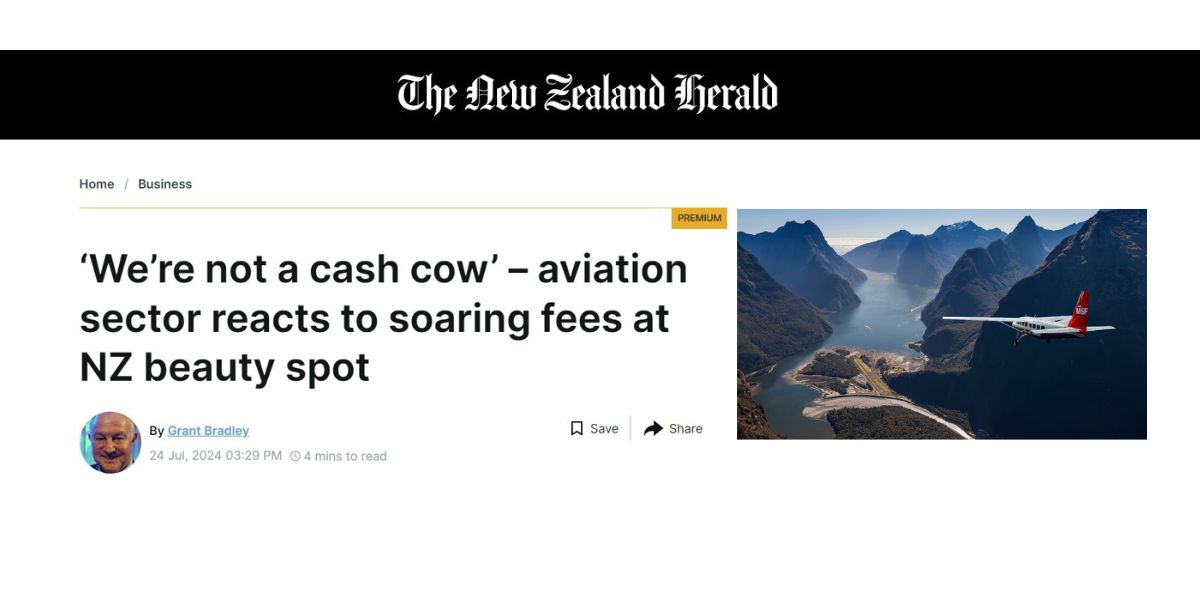
The announcement last Friday by the Associate Transport Minister Matt Doocey, of significant increases in landing charges at the Milford Aerodrome, is just another example of both central and local government agencies treating aviation as a cash cow.
In the case of Milford, landing fees are set to increase 176% with effect from 1 April 2025. This will take the fee for a fixed wing aircraft at over 2000kg from $73 to $202 and for a helicopter from $25 to $69. The charges are being defended by the Ministry of Transport (MOT) on the basis that current landing charges are too low to cover the aerodrome’s operating costs and haven’t changed since 2011.
There may be some justification for an increase, but the magnitude of the increases that have been confirmed are not sustainable for commercial operators. The modelling has been based on 2025-2027 costs of $3.2 million to operate Milford, with half of this, $1.6 million, going to management and consultant fees. In a time when the Government is focused on fiscal constraint, there needs to be more scrutiny of such costs which are then being absorbed by aviation operators.
Only so much can be passed on to customers before they are not prepared to pay any more and the operators lose competitiveness – in other words, there is a price elasticity point. While the tourism industry has seen a welcome uptick in activity post-Covid, it is nowhere near pre-pandemic levels. Indeed, figures released by Statistics New Zealand last week show visitor numbers at 80% of 2019 levels. Add to this an increase announced in the Budget for the International Visitor Levy (IVL), and New Zealand will lose competitiveness.
The Milford situation is just the tip of the iceberg and symptomatic of a much wider problem. We have already seen Auckland Airport recently announce significant increases in landing charges affecting our members’, albeit Wednesday’s announcement from the Commerce Commission is helpful (see below). Meantime, the maximum certificated take-off weight or MCTOW is hitting operators, particularly those in the agricultural sector.
It is nonsensical to be charging such operators on their MCTOW when under Part 137 requirements they can’t land at that rate. The agricultural and wider primary production sectors are experiencing challenging trading conditions, and when the likes of Hamilton Airport propose significant increases, it is a real kick in the guts.
What is even more galling about the situation with landing charges is the lack of consultation by airports, many of which are owned, part-owned or operated by local government entities. The AIANZ with its limited resource must pick off one airport at a time to challenge decision-making around the arbitrary setting of fees.
But it’s not just landing fees. As members will know, the Association and others have been advocating strongly against the proposed FENZ levies which would place many commercial operators at financial risk. Again, the methodology and evidence base used by FENZ to underpin the proposed levy increase is flawed.
The Funding Review is due in October, and indications the AIANZ has had from the CAA and the MOT, indicate ‘material’ increases in fees. As an industry we will need to mount an evidence-based case to counter the proposed increases and central to our argument will be the need for CAA to deliver what the Minister of Transport Simeon Brown recently labelled, a ‘customer-centric’ organisation.
The AIANZ will keep the so-called squeaky wheel greased, but we can’t do it alone and it’s going to need the collective will of the membership and the wider sector to make progress on all these matters. We are not a cash cow.
End.
Simon Wallace
Chief Executive, AIANZ